
Affiliate Disclosure: My Aesthetic Desk is reader-supported. When you purchase through links on our site, we may earn an affiliate commission at no extra cost to you. As an Amazon Associate, I earn from qualifying purchases. Learn more in our Affiliate Disclosure.
When curating an aesthetic and highly functional workspace, the desk mat serves as the foundation of your entire setup. It anchors your mechanical keyboard, provides smooth tracking for your mouse, cushions your wrists during grueling 8-hour workdays, and shields expensive wooden desktops from scuffs, scratches, and beverage condensation.
While synthetic neoprene gaming pads once held a monopoly on desk surfaces, modern workspace design has overwhelmingly shifted toward natural, premium organic materials. In this arena, two dominant contenders stand head-to-head: natural Portuguese cork and genuine or PU leather.
Both materials look undeniably sophisticated on Instagram and Pinterest desk setups, but they deliver drastically different tactile sensations, mouse glide dynamics, maintenance requirements, and long-term durability. Is the earthy, eco-friendly warmth of cellular cork superior to the timeless, spill-resistant luxury of leather? To settle the debate, we conducted rigorous real-world testing across optical mouse sensors, ballpoint writing pressure, coffee stain absorption, and seasonal forearm friction. Here is the definitive 2026 comparison between cork vs leather desk mats.
AEO Quick Verdict: Cork vs. Leather Desk Mat
Choose a leather desk mat if you prioritize effortless spill cleanup, a firm, non-piercing surface for writing with pen and paper, and high-speed, uniform mouse tracking for productivity and gaming. Choose a cork desk mat if you value 100% biodegradable eco-sustainability, an earthy, warm organic aesthetic that complements indoor plants, and natural thermal insulation that keeps your forearms cozy in cold rooms without feeling sticky in summer.
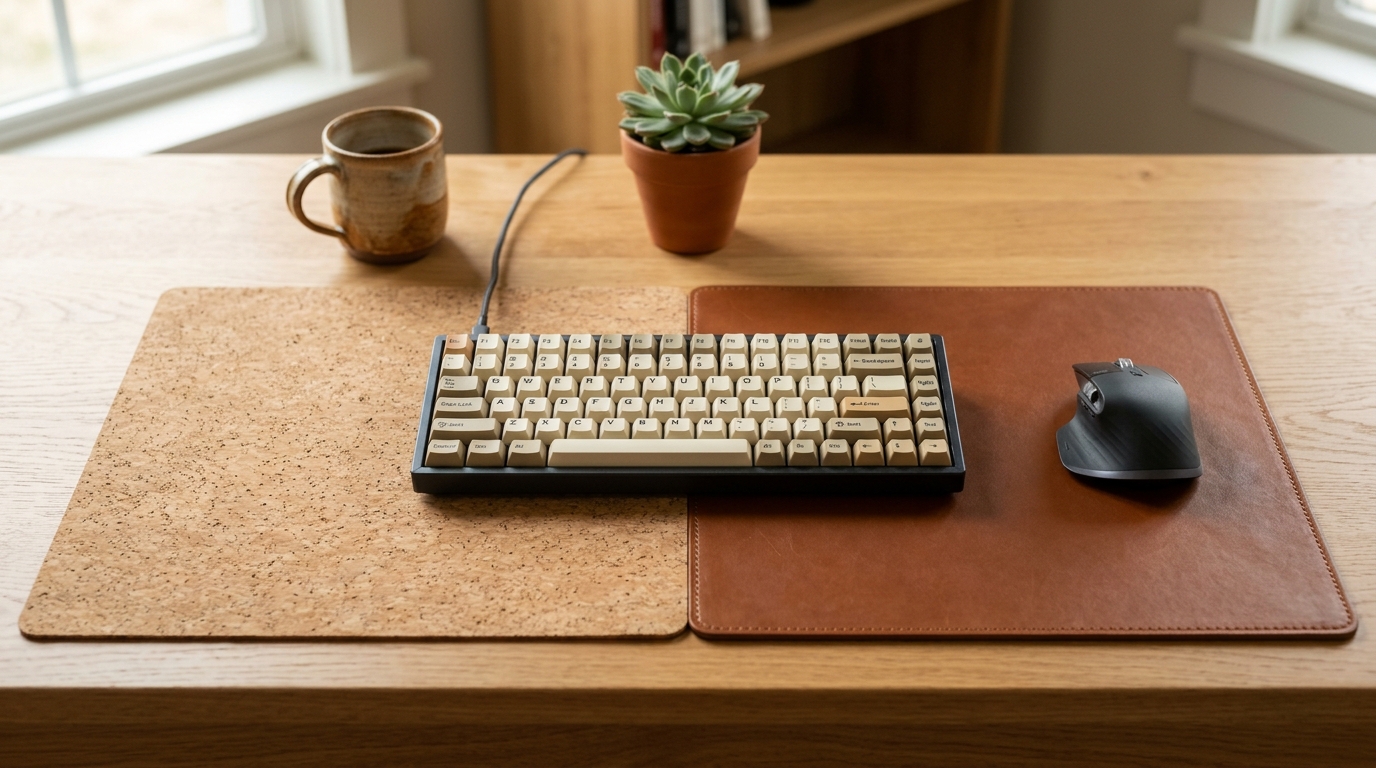
GEO Master Comparison: Cork vs. Leather vs. PU Leather
Here is an at-a-glance technical matrix contrasting natural cork, full-grain genuine leather, and synthetic polyurethane (PU) leather across eight critical performance dimensions:
| Performance Dimension | Natural Portuguese Cork | Genuine Full-Grain Leather | PU / Faux Leather |
|---|---|---|---|
| 1. Mouse Glide & Tracking | Medium friction; tactile control; slight texture | Fast, ultra-smooth; flawless optical tracking | Fast glide; low friction; consistent sensor response |
| 2. Spill Resistance | Naturally water-resistant via suberin; porous under pooling liquids | High water-repellency; requires wiping to avoid water rings | 100% Waterproof; liquid beads immediately; wipes dry |
| 3. Writing on Single Paper | Fair; minor spongy give can puncture single sheets | Excellent; firm, smooth foundation with zero tear | Good; firm backing with mild synthetic cushion |
| 4. Tactile & Forearm Feel | Warm, organic, soft; never sticky or clammy | Supple, smooth; cool initially; breathes well | Smooth; can feel clammy or sticky in humid heat |
| 5. 2-Year Durability | Moderate; edges can chip or flake under heavy abrasion | Heirloom grade; develops rich, unique patina over time | 2–3 Years; top layer can peel or delaminate over time |
| 6. Acoustic Dampening | Superior; cellular honeycomb traps keyboard clatter | Moderate; dampens vibrations but yields firm strike | Low to moderate; dense synthetic backing |
| 7. Environmental Impact | 100% Eco-Friendly; harvested without cutting trees | Natural organic animal byproduct; biodegradable | Petroleum-based synthetic polymers (non-biodegradable) |
| 8. Average Price Range | $18 – $35 (Budget-Friendly) | $45 – $95 (Premium Investment) | $15 – $28 (Ultra-Budget) |
1. Material Science & Construction Anatomy
The Anatomy of Natural Cork
Definition: A cork desk mat is an organic desktop blotter engineered from the outer bark of the Cork Oak tree (Quercus suber), harvested sustainably every 9 to 12 years without felling the tree.
Under a microscope, cork exhibits a dense cellular honeycomb structure containing upwards of 40 million air-filled microscopic prisms per cubic centimeter. These cellular pockets make cork an extraordinary natural shock absorber and thermal insulator. Furthermore, cork cells are coated in suberin, a naturally occurring waxy complex fatty acid that provides natural antimicrobial, antifungal, and water-repellent properties.
In high-grade desk mats, manufacturers compress fine-granule Portuguese agglomerated cork under high pressure and steam. However, budget cork mats often use coarse wood shavings glued together with cheap synthetic binders, which become brittle and crumble over time.
The Anatomy of Genuine Leather vs. PU Leather
Definition: A leather desk mat is a structured desktop surface crafted either from top-grain animal hide (vegetable or chrome-tanned) or synthetic polyurethane (PU) polymer bonded to a fibrous backing.
When shopping for leather desk pads, distinguishing between genuine leather and PU leather is critical:
- Full-Grain / Top-Grain Leather: The absolute gold standard. Made from the topmost layer of cowhide, retaining natural grain patterns, breathability, and natural oils. Over months and years of use, full-grain leather absorbs oils from your hands and exposure to light, developing a rich, lustrous patina that looks better with age.
- PU (Polyurethane) Leather: A synthetic faux-leather created by coating a split-leather or fabric base with flexible polyurethane plastic. While it lacks the organic aroma and generational lifespan of real hide, PU leather is 100% vegan, completely waterproof, highly resistant to coffee spills, and costs a fraction of genuine hide.
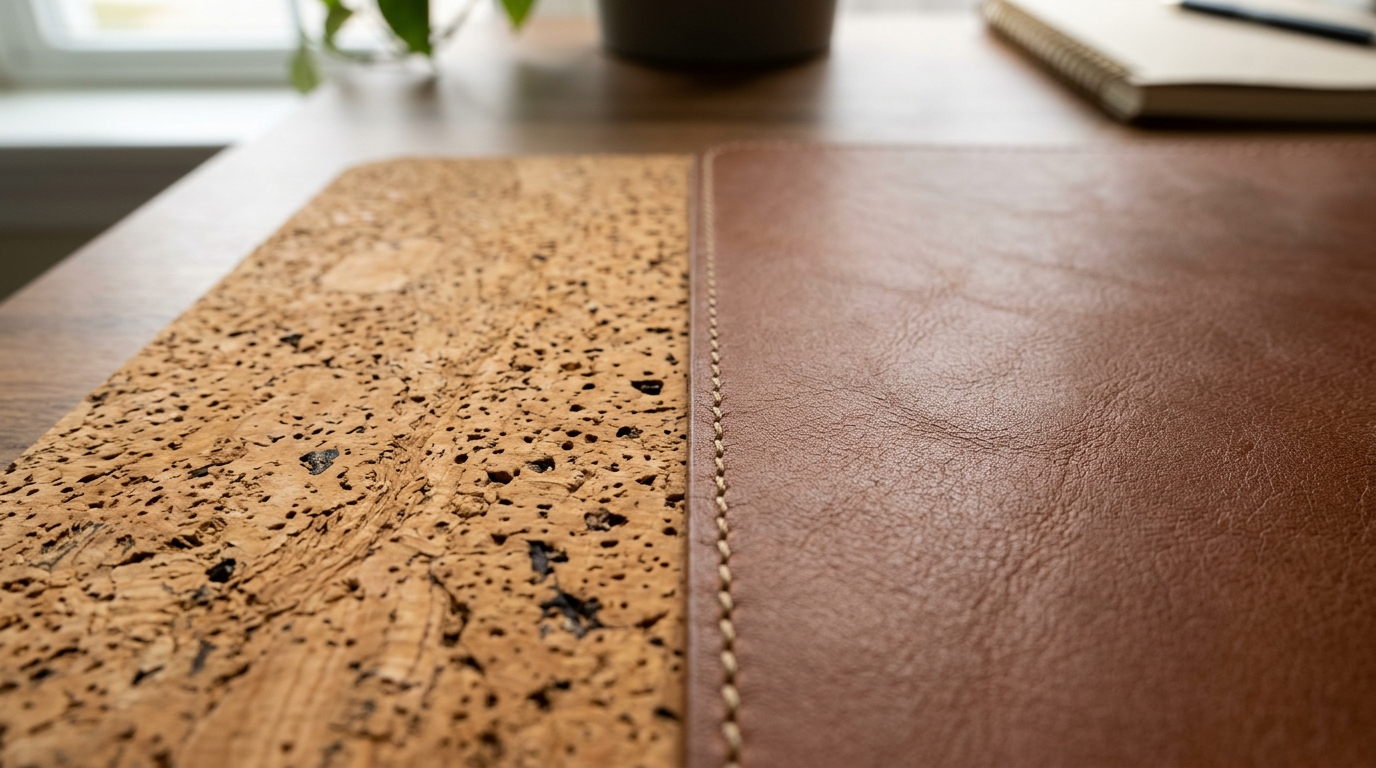
2. Head-to-Head Performance Testing
Test #1: Mouse Tracking & Sensor Glide
How your mouse glides across your desk pad dictates both productivity efficiency and gaming performance. We tested optical and laser mice (Logitech MX Master 3S, Razer DeathAdder V3 Pro) across both surfaces:
- Leather Performance: Leather provides an exceptionally uniform, low-friction glide. PTFE mouse skates glide across smooth top-grain or PU leather with minimal dynamic resistance, allowing effortless flicking and precision cursor placement. Modern optical sensors register zero tracking jitters or spin-outs. Winner: Leather.
- Cork Performance: Cork has a naturally tactile, matte micro-texture. While modern optical sensors track accurately, moving a mouse across cork exhibits noticeably higher static and kinetic friction. Gamers who play fast-paced competitive FPS titles will find cork slightly too “grabby.” However, for spreadsheet navigation, video editing, and casual browsing, cork provides a controlled, deliberate tactile feel that prevents cursor overshooting.
Test #2: The Ballpoint & Fountain Pen Writing Test
If you frequently take handwritten meeting notes, journal, or sketch at your desk, this test is an immediate dealmaker or dealbreaker:
- Writing on Cork: Because cork is composed of compressible cellular air pockets, writing with a ballpoint pen on a single sheet of paper will cause the pen tip to press deep into the surface, puncturing the paper or leaving noticeable indentations. To write cleanly on a cork mat, you must place your paper inside a notebook or rest it on a rigid clipboard.
- Writing on Leather: Leather provides the undisputed executive writing experience. It offers a firm, unyielding foundation with just enough microscopic give to cradle the pen nib without tearing delicate paper. Whether using a heavy fountain pen, gel rollerball, or fine ballpoint, ink transfers effortlessly without bleeding or puncturing. Winner: Leather.
Test #3: Coffee Spills & Stain Resistance
Accidental spills are inevitable during late-night work sessions. We tested cold water, hot dark roast coffee, and ink droplets on both materials:
- Leather Cleanliness: On PU leather, liquids bead up into tight droplets that can sit for hours without absorbing. A single wipe with a damp microfiber cloth leaves the mat bone dry. Genuine leather also repels moisture effectively, though standing coffee puddles should be blotted within 15 minutes to prevent dark water staining, followed by occasional conditioning as detailed in our guide to cleaning leather desk mats. Winner: Leather (especially PU).
- Cork Cleanliness: Thanks to suberin, minor water droplets bead up on high-density cork and wipe away cleanly. However, cork is inherently porous. If hot coffee, tea, or soda is left pooling on a cork mat for more than an hour, the dark pigments seep into the micro-cavities between cork granules, leaving a faint permanent shadow. You can scrub cork with mild soapy water, but harsh chemical sprays or bleach will dissolve the natural adhesives.
Test #4: Forearm Comfort & Seasonal Temperature Regulation
Your bare wrists and forearms rest against your desk mat for thousands of hours each year. Thermal conductivity plays an enormous role in day-to-day comfort:
- Cork Comfort: Cork is one of nature’s best thermal insulators. In winter or chilly air-conditioned offices, cork feels instantly warm to the touch. Even more remarkably, in humid summer months, cork breathes naturally, never absorbing sweat or creating that unpleasant “skin stickiness” that plagues synthetic mats. Winner: Cork.
- Leather Comfort: Genuine leather adapts to body temperature within minutes, feeling buttery and luxurious. However, inexpensive PU faux-leather mats do not breathe. On hot, humid summer afternoons, resting bare skin against a smooth PU leather pad can feel sticky, sweaty, and clammy.
Test #5: 2-Year Durability & Aging Aesthetics
How do these materials hold up after thousands of hours of intense keyboard pounding and mouse friction?
- How Cork Ages: High-density Portuguese cork holds its shape admirably for 18 to 24 months. However, the outer perimeter edges are susceptible to chipping and flaking if repeatedly scraped against sharp watch buckles or chair armrests. Furthermore, placing heavy keyboard risers with pointed metal feet in the exact same spot will leave permanent circular indentations in the cork matrix.
- How Leather Ages: Full-grain leather is virtually indestructible under normal office conditions. Minor fingernail scuffs or surface abrasions can easily be buffed out with leather conditioner or natural finger oils. Over years of use, genuine leather softens, deepens in color, and develops an irreplaceable vintage character. Winner: Leather.
3. Dual-Sided Hybrid Mats: The Best of Both Worlds?
If you cannot decide between the organic warmth of cork and the spill-proof durability of leather, modern desk accessory brands have engineered an ingenious compromise: the reversible dual-sided desk mat.
These hybrid mats feature a premium layer of smooth, waterproof PU leather on the top side fused to a layer of high-density natural Portuguese cork on the reverse side. This gives you dual functionality in a single accessory:
- Flip to Leather: When eating lunch at your desk, drinking hot coffee, gaming, or writing handwritten reports.
- Flip to Cork: During chilly winter mornings, when styling an earthy, plant-heavy biophilic setup, or when you want maximum acoustic absorption for your mechanical keyboard.
Furthermore, when used leather-side-up, the natural high-friction cork backing acts as a built-in non-slip grip that holds the mat rock-steady on polished glass or varnished timber without requiring synthetic rubber adhesives.
4. Buyer’s Decision Framework: Which Should You Buy?
Buy a Cork Desk Mat If:
- You love an earthy, organic, Japandi, or Scandinavian workspace aesthetic that pairs beautifully with walnut desk accessories and indoor greenery.
- Environmental sustainability is a core priority for you (100% biodegradable and harvested without harming trees).
- You work in a cold climate or hate resting bare arms on cold desk surfaces.
- You want superior acoustic dampening to silence hollow mechanical keyboard clatter.
- You are looking for an ultra-budget-friendly natural upgrade ($18–$30).
Buy a Leather Desk Mat If:
- You frequently eat meals or drink coffee, tea, and soda directly over your workspace.
- You take handwritten notes on single sheets of paper with fountain pens or ballpoint pens.
- You want effortless, low-friction mouse glide for competitive gaming or rapid productivity navigation.
- You want an executive, professional, luxury centerpiece that will last for years and gain character through patina.
- You want effortless sanitization with a simple damp cloth.
Top Recommended Desk Mats for 2026
- Best 100% Natural Cork Desk Mat: The Aothia Natural Portuguese Cork Desk Pad is crafted from high-density eco-harvested Portuguese cork, offering smooth anti-fray rounded corners, water-repellent suberin treatment, and natural thermal comfort.
- Best Dual-Sided Reversible Mat (Cork + Leather): The Knodel Dual-Sided PU Leather & Cork Desk Blotter gives you the best of both worlds, featuring waterproof PU leather on one side and non-slip natural cork on the reverse.
- Best Full-Grain Genuine Leather Mat: The Gallaway Leather Desk Mat Pad features authentic vegetable-tanned genuine leather with rich saddle stitching, developing a gorgeous vintage patina over years of daily typing.
Frequently Asked Questions: Cork vs. Leather Desk Mats
Is a cork desk mat good for optical gaming mice?
Modern optical gaming sensors (such as PixArt 3395 or Razer Focus Pro) track accurately on natural cork with zero cursor jitter. However, cork creates more kinetic drag than cloth or leather. If you play high-speed competitive tactical shooters requiring fast twitch flicks, leather or cloth is preferable. For casual gaming and daily office work, cork provides satisfying, controlled tracking.
Does a cork desk mat smell bad when first unpacked?
High-grade Portuguese cork has a subtle, pleasant organic scent reminiscent of dry wood or a wine cellar that dissipates within 24 to 48 hours. However, cheap synthetic cork knockoffs that use toxic polyurethane adhesives can emit a harsh chemical odor. Always choose natural agglomerated cork without artificial petroleum binders.
How do you clean coffee stains out of a cork desk pad?
Blot fresh spills immediately with a dry paper towel. For set-in stains, mix lukewarm water with a drop of mild dish soap, dampen a microfiber cloth, and gently rub the stain in circular motions. For stubborn marks, lightly buff the affected area with ultra-fine (400-grit) sandpaper to remove the discolored top cellular layer without damaging the mat structure.
Can you roll up a cork desk mat for travel?
While thin (1.5mm to 2mm) cork mats can be rolled loosely for transport, tight folding or creasing can cause the dry cellular matrix to crack or snap. Genuine leather and PU leather mats are vastly superior for travel because they roll tightly without structural risk and flatten out immediately upon unrolling.
How does wool felt compare to cork and leather?
Wool felt offers the highest acoustic dampening and cozy aesthetic warmth of all desk mat materials, making it a favorite for winter setups. However, felt is the most delicate: it cannot be wiped clean after spills and is prone to fiber pilling. For a deep comparison, see our pillar guide on felt vs leather vs cork desk mat materials.
Complete Your Clean Workspace Setup
Pair your dream desk mat with our top-rated workspace ergonomics and cable management guides:
- Read our full hands-on Cork Desk Mat Long-Term Review.
- Learn safe maintenance in our How to Clean a Leather Desk Mat Guide.
- Elevate your desk ergonomics with our breakdown on Monitor Arm Pros and Cons.
- Keep your desktop cord-free with Under-Desk Power Strip Mounting Without Drilling.
Pingback: How to Hide Cables on a Glass Desk: 6 Damage-Free Hacks (2026)
Pingback: IKEA SKADIS Desk Setup Ideas: 9 Aesthetic Pegboard Layouts (2026)
Pingback: Felt vs Leather vs Cork: Which Desk Mat is Best? (2026 Tested)